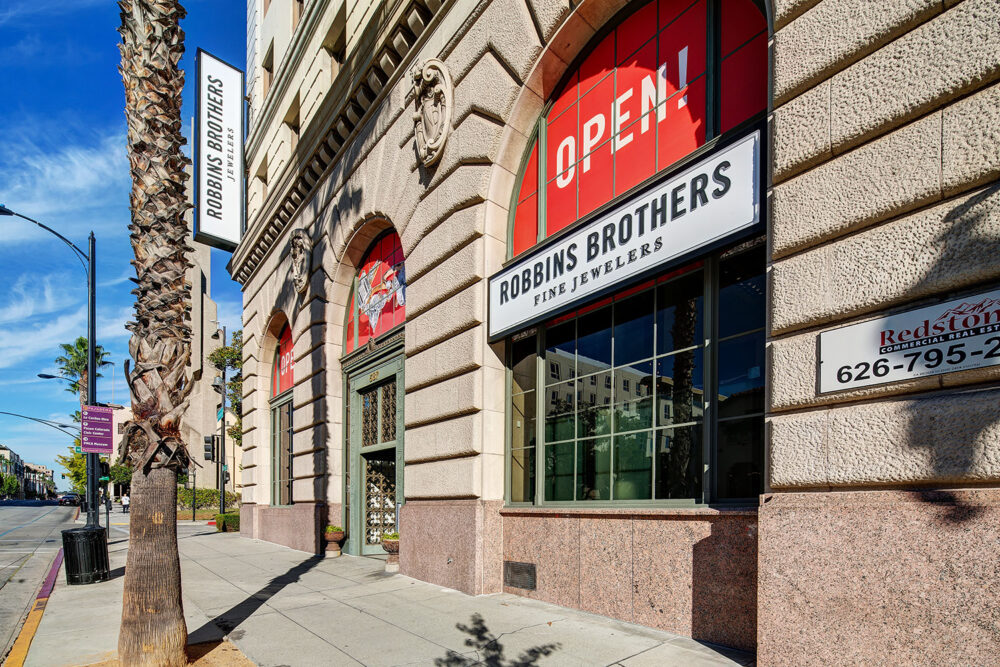
PASADENA, Calif. — Robbins Brothers’ new flagship store occupies the ground floor of a nine-story, 102-year-old building in Pasadena, Calif. — a space with 30-foot ceilings, ornate historic columns and windows that stretch 28 feet tall and 20 feet wide. None of it could be drilled, tapped or altered.
Somewhere inside those constraints, Everon had to build a complete security, video and access control system.
The project earned Everon and Robbins Brothers the Integrated Installation of the Year honor in Security Sales & Integration’s 2026 SAMMY Awards.
“I was like, ‘oh my God, this thing looks like the Taj Mahal,'” says Leonel Cid, national account manager at Everon, recalling the first video he saw of the space. “It’s beautiful. You do not want to be drilling into anything here.”

A Decade-Long Relationship Pays Off
Everon and Robbins Brothers didn’t start from scratch in Pasadena. Cid has worked with Alan Flaesgarten, vice president of IT at the 14-store jewelry retailer, for about 10 years, a relationship that began when Everon, then operating as ADT Commercial, converted the legacy alarm systems at Robbins Brothers locations across California, Arizona, Texas and Washington.
That history meant Everon’s team got involved in the Pasadena project long before ground was broken — about four months of engineering work preceded the first screw turned on-site, according to Cid. It also meant Flaesgarten already understood what he needed from a security partner by the time planning began.
“In my world, especially in the IT space, we want to make sure we have as few vendors as possible,” says Flaesgarten. “If I have a vendor that can do multiple things for me, all the better, because there’s efficiencies in that.”
Cid describes the relationship in blunt terms: clients this decisive are rare.
“Quite honestly, so many times we meet with clients ahead of time and they’re not quite sure what they want,” he says. “He was very specific about what he wanted from the onset, which was great because that helps us do our job.”
“I trust Alan wholeheartedly with everything that he wants to do,” Cid says.
Everon operates as an agnostic integrator, handling access control, video, intrusion detection, intercom systems and fire alarm services across Robbins Brothers’ full portfolio.
For the Pasadena flagship location, that meant layering a security system, camera network and door access system into a flagship location that also houses the retailer’s corporate offices on the upper floors, each system carrying its own set of challenges before anyone accounted for the building itself.
Once construction began, the two companies settled into a weekly rhythm, meeting on-site or over video call to keep project management on track across both organizations.
Cid describes it as a genuinely collaborative relationship rather than a standard vendor arrangement, one where Everon’s project managers, installers and engineers worked alongside Robbins Brothers’ general contractor and property manager from the earliest planning meetings rather than being looped in once the rest of the buildout was already decided.

Photo courtesy of Robbins Brothers
Preserving History with an Eye to the Future
The historic building’s protections created problems Flaesgarten says he had never encountered anywhere else. Cameras, motion detectors and cabling all needed a place to go in a structure where the walls, ceilings and columns were largely off-limits.
“You had columns in the store, 30-foot ceiling that you couldn’t mount anything to,” says Flaesgarten. “So where do you put cameras? Where do you put your motion detector?”
By the time Everon’s engineers arrived, Flaesgarten had already worked out custom enclosures to wrap around the building’s columns, hiding cabling and mounting hardware beneath decorative covers rather than running anything across the historic surfaces. Cid says his own engineering team was scrambling to keep pace.
“Our eyes were in the back of our heads by the time we finished,” he says. “Alan was a real revolutionary from that perspective with this building.”
The retail floor wasn’t the only complication. A man trap greets customers at the entrance, door fobs secure internal doors throughout the store, and the project had to account for a new sales approach entirely: a side-by-side case that puts staff next to customers rather than across from them.
“We’ve changed the way we sell to our customers in this location with something called a side-by-side case,” says Flaesgarten, noting the new setup required its own coverage and alarm considerations compared with the retailer’s traditional layout.
Racing to the Finish Line
Everon and Robbins Brothers had roughly eight to 12 weeks from the start of on-site work to the store’s opening, on top of the four months of engineering that preceded it. Much of that window came down to coordination around the building’s fire egress requirements, the man trap’s compliance with handicap access rules and a door fob system that had to satisfy the city and fire marshals at the same time.
Flaesgarten says the team hit a handful of close calls before the store’s opening but Everon’s responsiveness kept the project on schedule, including after Robbins Brothers discovered some of its early access assumptions needed revising once employees started using the space day to day.
Cid says Flaesgarten’s willingness to let Everon’s crews work evenings and weekends made a meaningful difference for both the schedule and the quality of the finished work, since fewer trades competed for space on-site at the same time.
That flexibility mattered most in the earliest days on-site, when securing the building’s contents took priority over finishing every system.
“We wanted to make sure that they at least were able to secure that property for a sense of even setting the alarm out there,” Cid says, noting the volume of inventory moving into the building made protecting it an immediate priority regardless of which doors were fully operational yet.
Getting to that point required its own coordination beyond Everon and Robbins Brothers alone. Cid estimates the two companies held roughly half a dozen meetings early in the process with the project’s general contractor and property manager, all working from the same set of expectations before construction began in earnest.

Photo courtesy of Robbins Brothers
Wired, Wireless and Everything in Between
With three systems going in simultaneously, security, video and access control, cable routing became its own engineering puzzle. Drilling through the building’s marble floor was possible only in limited, carefully chosen spots.
“My cost to drill through the marble floor was, you know, outrageous and I could only do it in certain spots,” says Flaesgarten.
Where existing conduit ran beneath the floor from the building’s basement, Everon’s team used it. Where it didn’t, portions of the system went wireless instead.
“Can we have Cat-6 and the alarm system in the same pipe? No, not if you want good video,” says Flaesgarten, describing the tradeoff that pushed some runs to wireless rather than risk video quality.
The finished system ended up as a deliberate mix of both approaches, chosen area by area based on what the building’s structure would allow rather than a single standard applied everywhere.
Flaesgarten calls it the most complex project of his career, more demanding than any other Robbins Brothers store buildout.
The building also introduced a security dimension the retailer hadn’t dealt with before: unlike Robbins Brothers’ typical freestanding stores, the Pasadena location shares common hallways and an elevator with the rest of the building, meaning Everon’s system had to account for foot traffic the retailer doesn’t fully control.
“I want to be able to sit at my desk and see all my doors,” says Flaesgarten of the design goal, adding that the system now lets staff monitor who is moving through the building at any given time.
An Approach for the Long Haul
Two more Robbins Brothers projects are already in progress, one a relocation and the other a refresh, according to Flaesgarten, and Cid expects the same model, early engineering involvement, close coordination and an established level of trust, to carry into both.
Cid says the Pasadena project also reflects a broader shift he’s seeing across Everon’s national accounts: away from proprietary, single-purpose systems and toward integrated platforms built around what a client’s operations actually need, rather than forcing operations to adapt to whatever a system happens to do.
That approach, he says, is easier to replicate consistently across a growing store count, since the requirements stay defined by the client rather than by whichever vendor’s software happens to be installed.
For Flaesgarten, the payoff of that consistency is straightforward. Knowing Everon’s timelines, lead times and hardware options in advance let him flag store-specific challenges to Cid’s team early, well before construction crews were on-site, often framing new locations as variations on a store Everon had already secured.
A location with 12 doors instead of 10, for instance, could be scoped as a known template with a handful of adjustments rather than a project starting from zero.
A Client’s-Eye View
For Cid, the clearest measure of the project’s success came at the store’s grand opening, when he had a chance to see the finished space the way a customer would rather than as a set of engineering drawings.
“I’m experiencing this location as a client,” says Cid, recalling the moment. “This is exactly what we envisioned when we first sat down and started putting the plan together.”
It’s a perspective Cid says he rarely gets on a project, since most engagements end at handoff rather than at a grand opening.
“Most of the time it’s like, ‘okay, well, it meets the spec,'” he says.
Watching customers actually move through the finished space was different and it’s a lesson he’s carrying into how he approaches every project going forward.
It’s that moment, more than the technical complexity of the build, that Cid points to when explaining why Everon submitted the Pasadena project for 2026 SAMMY Awards Integrated Installation of the Year consideration over other installations completed in the same period.
Flaesgarten, for his part, credits the partnership itself, one built well before Pasadena and likely to continue well past it, for making the project work at all.